
Value for Tax Dollars: Looking Beyond the Tax Bill
Every election cycle, property taxes become one of the most discussed topics in Niagara-on-the-Lake. Residents often hear that taxes are too high, taxes are too low, or that another municipality is doing a better job.
The reality is that comparing municipalities is not as simple as looking at a tax bill.
A recent comparison shared by Newmarket Mayor John Taylor highlighted municipal tax levies per capita across Ontario. The data, based on the BMA Municipal Study and Fraser Institute analysis, ranked municipalities according to how much municipal tax levy is collected per resident.
What is interesting is not where Newmarket sits.
It is where Niagara-on-the-Lake would sit.
The Numbers
Niagara-on-the-Lake’s 2026 municipal tax levy is approximately $18.16 million.
With a population of approximately 20,863 residents, that equates to roughly:
$871 per resident
For comparison:
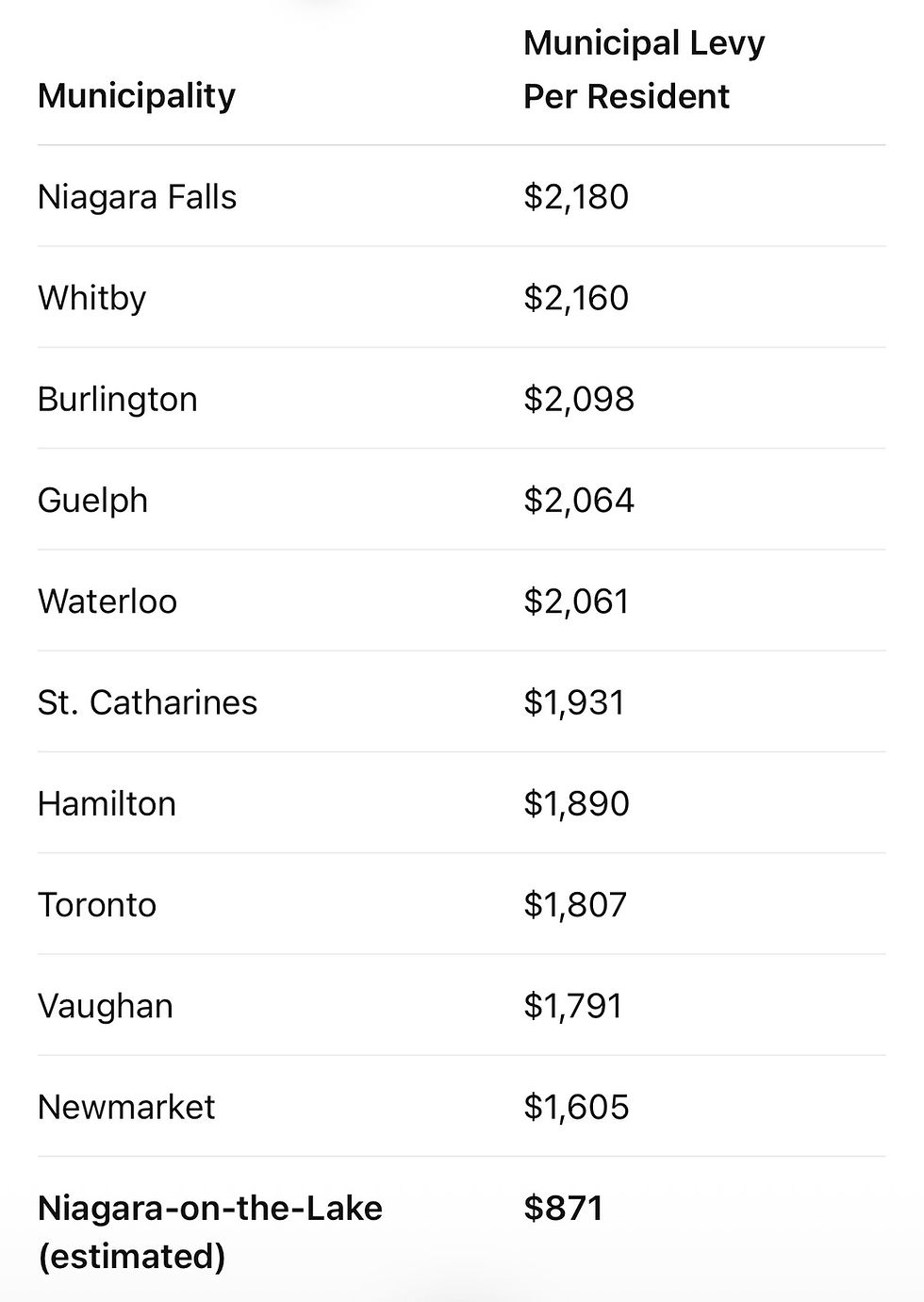
If Niagara-on-the-Lake were included in the study, it would likely be among the lowest municipal tax levies per resident in Ontario.
That is a remarkable statistic.
Why Is NOTL Different?
Unlike most municipalities, Niagara-on-the-Lake serves far more people than simply its permanent population.
We have:
Over 3.5 million visitors annually
More than $3 million annually in Municipal Accommodation Tax (MAT) revenues
Approximately $3 million annually in parking revenues
A strong winery, hospitality and tourism sector
Significant commercial assessment that helps support municipal services
Simply put, visitors and businesses help contribute to the cost of running the Town.
This allows Niagara-on-the-Lake to maintain services while spreading costs across a broader economic base.
What Residents Actually Care About
While per-capita comparisons are interesting, homeowners don’t receive a bill based on population.
They receive a bill based on property assessment.
That is why looking solely at tax rates can also be misleading.
The better question is:
What value are residents receiving for their tax dollars?
What Taxpayers Receive
Niagara-on-the-Lake maintains:
Heritage districts and heritage properties
Community centres
Playgrounds and parks
Recreation programming
Trails and open spaces
Roads and infrastructure
Libraries
Fire protection
Bylaw enforcement
Tourism infrastructure
Cultural events and facilities
All while serving millions of annual visitors.
Few municipalities of our size face the same level of demand.
The Hidden Costs of Tourism
Visitors enjoy:
Queen Street
Our parks
Waterfront spaces
Public washrooms
Parking lots
Heritage areas
Trails
Special events
These services require staffing, maintenance, infrastructure investments and ongoing replacement.
The challenge is balancing those needs while protecting taxpayers.
Fortunately, tourism revenues help offset many of these costs.
The Other Side of the Equation
It is easy to focus only on taxes.
However, taxpayers should also ask:
What is the municipality’s debt?
What services are being delivered?
What infrastructure is being maintained?
What investments are being made for future generations?
What portion of costs are being offset by visitors and businesses?
A municipality can have low taxes by simply not investing in roads, facilities and infrastructure.
That is not a sustainable strategy.
Likewise, a municipality can have high taxes while delivering poor value.
Neither approach serves residents well.
The Niagara-on-the-Lake Advantage
Niagara-on-the-Lake is fortunate to have a unique economy.
Our tourism sector, hospitality industry, wineries, accommodations and commercial businesses help support municipal services that otherwise would fall directly on residents.
That does not mean we should stop looking for efficiencies.
It does mean we should recognize the value that our local economy brings to taxpayers.
The Real Conversation
Rather than asking whether taxes are high or low, perhaps the better question is:
Are residents receiving good value for their tax dollars?
When you consider:
One of the lowest municipal levies per resident in Ontario
Millions of dollars in visitor-generated revenues
World-class heritage and tourism assets
Significant investments in parks, recreation and community services
A municipality that serves millions of visitors annually
Niagara-on-the-Lake has a strong story to tell.
The challenge is ensuring we continue to balance responsible financial management with the services and infrastructure residents expect today and future generations will need tomorrow.
Because value is not measured simply by the size of a tax bill.
It is measured by what that tax bill delivers.


Comments