
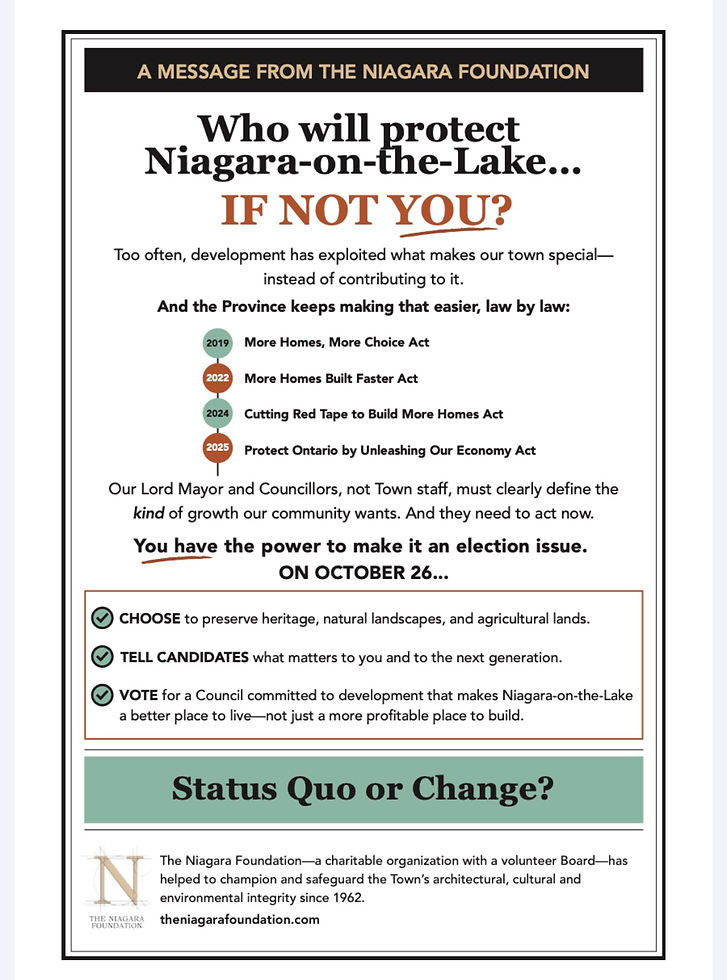
A Response to Niagara Foundation’s recent advertisements.
Preserving the Past While Planning for the Future: Why Context Matters More Than Percentages
A response to the Niagara Foundation’s recent advertisement and the importance of fairness, transparency and neutrality during a municipal election.
Niagara-on-the-Lake is a community that takes tremendous pride in its history, heritage and character.
I share that pride, and throughout my term on Council, I have worked to balance protecting what makes our Town special with planning responsibly for its future.
That is why I was disappointed to see the Niagara Foundation publish an advertisement criticizing this Council’s approval of Official Plan and Zoning By-law amendments without providing residents with the full context behind those decisions.
The advertisement suggests that approving planning amendments is somehow evidence of poor planning or a failure to protect our community.
But is that really the case?
Do They Oppose All Planning Amendments?
Let’s consider some of the community institutions and projects that make Niagara-on-the-Lake what it is today.
The Niagara-on-the-Lake Museum: An important institution dedicated to preserving and sharing our community’s history. Its property has been subject to zoning amendments.
The Glendale Transit Hub: An important component of planning for our community’s future transportation needs within the broader Glendale planning framework.
The Shaw Festival’s Royal George Theatre redevelopment: A proposal that required Official Plan and Zoning By-law amendments.
Red Roof Retreat: A valued community organization providing services and support to children and young adults with special needs and their families.
These examples raise an important question.
Does the Niagara Foundation oppose these types of community projects simply because planning approvals or amendments are required?
I would hope not.
The reality is that Official Plan and Zoning By-law amendments are legitimate tools within Ontario’s planning legislation.
They allow municipalities to consider how land uses should evolve as community needs change.
Some amendments support heritage preservation.
Others facilitate cultural institutions, community services, transportation infrastructure, housing, tourism and economic development.
Not every amendment is appropriate, and not every development deserves approval.
But an amendment itself is not evidence of bad planning.
What matters is what is being proposed, why it is being proposed, and whether it represents good planning for our community.
Let’s Talk About That 93%
According to the Niagara Foundation’s advertisement, this Council approved:
72 Zoning By-law amendments
21 Official Plan amendments
A 93% approval rate
Those are the figures presented by the Foundation, and I have not independently verified them against the Town’s official planning records.
So my first question to the Niagara Foundation is simple:
Can you please provide the municipal report or reference used to establish these numbers?
And equally importantly, can you provide the complete list of applications and the methodology used to calculate that 93%?
I believe residents deserve to know:
How many were minor or technical amendments?
How many were initiated by the Town rather than private developers?
How many supported public infrastructure, community facilities or heritage-related objectives?
How many involved both an Official Plan amendment and a Zoning By-law amendment for the same development?
How many applications were refused, withdrawn or substantially revised?
What time period was used, and which applications were included in the calculation?
Without those answers, a percentage tells residents very little about the quality of the decisions made.
A 93% approval rate does not automatically mean Council approved 93% of proposed developments, nor does it establish that those approvals were inappropriate.
Context matters.
And when statistics are being used to influence public opinion during an election, accuracy and transparency matter even more.
Heritage Protection and Responsible Growth Are Not Opposing Goals
This Council has also undertaken significant work to strengthen heritage protection, including advancing additional heritage designations and the planning framework for the Queen Street Heritage Conservation District.
These are examples of municipal planning decisions intended to preserve the very character that makes Niagara-on-the-Lake special.
Heritage conservation districts are established through a different legislative process than ordinary zoning amendments, but they demonstrate why it is important to look at Council’s full planning record rather than one isolated statistic.
I have supported development applications when I believed they represented good planning and benefits for our community.
I have also opposed developments when I believed the scale, density, massing, location or impact was inappropriate.
My voting record demonstrates that I do not believe every application deserves approval.
But I also do not believe every application deserves rejection simply because it involves change.
Responsible planning requires judgment, not blanket opposition.
The Responsibility of Foundations and Community Associations During an Election
There is another important issue that deserves discussion.
What responsibility do foundations, associations and community organizations have when they present themselves as representing the interests of an entire community?
Organizations such as the Niagara Foundation play an important role in advocating for heritage preservation, educating residents and encouraging public participation.
Their contributions can be valuable.
But with that public influence comes responsibility.
When an organization presents itself as speaking for the broader community, residents should be able to trust that its communications are factual, balanced and transparent about the organization’s positions.
This becomes particularly important during a municipal election.
There is a meaningful difference between advocating for a cause and using an organization’s platform to influence how residents perceive particular candidates or an elected Council.
A foundation can advocate strongly for heritage preservation without suggesting that every planning amendment represents a failure.
A community association can disagree with Council decisions without implying that its position represents the views of every resident.
And an organization can participate in public debate while being transparent about whose views it represents and how those positions were determined.
Not every resident agrees on development.
Not every heritage advocate opposes growth.
Not every business owner supports every commercial project.
And not every resident believes that saying “no” is the best way to protect Niagara-on-the-Lake.
Our community is made up of many different voices, and no single organization should presume to speak for all of them.
Advocacy Versus Political Neutrality
I want to be clear: community organizations have every right to advocate for their mandates and participate in discussions about municipal policy.
I welcome that participation, even when we disagree.
But there is an important distinction between issue-based advocacy and election-related political activity.
Registered charities in Canada are permitted to engage in non-partisan public policy dialogue and development activities that further their charitable purposes.
They are not permitted to directly or indirectly support or oppose a political party or candidate.
Separately, Ontario’s municipal election rules establish requirements for certain third-party advertising activities. (“Status quo”)
Whether any particular communication falls within those rules depends on its content, purpose and circumstances.
I am not suggesting that disagreement with Council automatically constitutes political campaigning or a violation of those rules.
What I am saying is that organizations should be especially careful about the accuracy, fairness and political neutrality of their communications when an election is underway.
If an organization presents statistics about an elected Council, those statistics should be supported by verifiable records.
If it takes a position on a municipal issue, it should be clear that this is the organization’s position, not necessarily the position of every resident.
And if it claims to represent a broad community interest, it should recognize the diversity of views within that community.
Credibility is built through transparency, consistency and fairness not selective information.
Protecting Our Heritage Also Means Protecting Our Future
Niagara-on-the-Lake is not a community frozen in time.
We are a living, working municipality with families, seniors, young people, agricultural businesses, cultural institutions, tourism operators and residents who depend on municipal services and infrastructure.
Our community needs responsible housing options.
It needs infrastructure investment.
It needs accessible transportation, recreation, cultural facilities and services for future generations.
And it needs strong heritage protections to ensure that growth respects the character of our Town.
These priorities are not mutually exclusive.
I have always believed that our responsibility as elected officials is to make informed decisions based on the merits of each application, the professional advice available, public input and the legislation we are required to follow.
Sometimes that means voting yes.
Sometimes that means voting no.
Leadership is not measured by how often you reject something. It is measured by the quality, integrity and long-term consequences of your decisions.
My Request to the Niagara Foundation;
I respectfully ask the Niagara Foundation to make available the municipal records supporting its stated figures of 72 Zoning By-law amendments, 21 Official Plan amendments and a 93% approval rate.
I also ask that the Foundation explain which applications were included, how the approval rate was calculated and whether the figures distinguish between minor amendments, Town-initiated changes and major development proposals.
Finally, I encourage the Foundation, and all community organizations participating in election-period discussions, to be transparent about the positions they take and the residents they represent.
Our community benefits from informed debate, including disagreement.
But that debate should be based on complete information rather than statistics presented without sufficient explanation.
Niagara-on-the-Lake deserves a conversation about what we are approving, why we are approving it and how those decisions shape our future not simply how many times Council voted yes.
I will continue to stand for responsible growth, meaningful heritage protection, fair treatment and transparent decision-making.
Because preserving the past while planning for the future is not a contradiction.
It is our responsibility.
Maria Mavridis

Councillor, Town of Niagara-on-the-Lake


Comments