
Development, Heritage & the Reality Behind the Work Being Done in NOTL
One thing residents may not always realize is that the development activity we are seeing today did not happen overnight.
During the last term of Council, Niagara-on-the-Lake was operating under an Interim Control By-law (ICBL), which temporarily restricted certain development and building applications while planning policies and studies were being reviewed. Shortly after, the world was hit with COVID-19.
For several years, many projects were effectively paused, delayed, or slowed significantly. Property owners, developers, businesses, builders, architects, and residents spent years waiting for approvals, studies, revised policies, supply chain recovery, and economic certainty.
So when this term of Council began, there was already a significant amount of pent-up demand.
Applications that had been sitting on hold were suddenly ready to move forward.
And the numbers clearly reflect that reality.
The Importance of Development in Niagara-on-the-Lake
Development is often discussed emotionally or politically, but the reality is that development is also what helps fund and sustain municipal services, infrastructure, heritage preservation, parks, recreation, roads, and community amenities.
A healthy economy requires responsible development and growth in order to remain sustainable.
Without investment, construction, redevelopment, and economic activity, municipalities struggle to maintain aging infrastructure, expand services, and keep up with rising costs.
Looking at the Town’s own statistics:
Estimated Value of Construction
2025: $95.7 million
2024: $213.4 million
2023: $167.6 million
2022: $97.9 million
Even with fluctuations year to year, these are massive levels of investment flowing into our community.
That means:
jobs for local trades
work for local suppliers
economic activity for businesses
increased assessment growth
permit revenue
infrastructure contributions
investment into existing buildings and heritage properties
Development Charges Help Build Infrastructure
Another important piece residents may not realize is that when construction begins, the Town collects Development Charges (DCs).
Those development charges help fund infrastructure needed to support growth, including:
sidewalks
roads
culverts
stormwater infrastructure
parks
recreation infrastructure
servicing upgrades
municipal growth-related capital projects
Growth does not simply create pressure on infrastructure — when managed properly, it also helps fund infrastructure improvements.
That is one of the reasons why sustainable and well-managed development is important to the long-term financial health of a municipality.
Building Permit Activity
The Building Department processed:
303 building permits in 2025
363 in 2024
430 in 2023
412 in 2022
And permit fees generated:
$829,215 in 2025
$834,025 in 2024
$1,068,207 in 2023
These are not small numbers.
Every permit represents:
reviews
inspections
engineering considerations
code compliance
zoning compliance
safety reviews
staff coordination
applicant meetings
documentation processing
Behind every permit is a significant amount of staff work that residents never see.
Planning Department Workload
The Planning Department has also been carrying an enormous workload.
Planning Applications in 2025
9 Official Plan Amendments
28 Zoning By-law Amendments
9 Draft Plans of Subdivision
7 Draft Plans of Condominium
11 Site Plan / Site Plan Amendments
5 NEC Development Permit Applications
For a total of:
69 Planning Applications
That is actually an increase over previous years.
At the same time:
63 pre-consultation meetings were held
38 Committee of Adjustment applications were processed
These applications involve:
staff reports
technical circulation
engineering review
environmental review
legal review
heritage review
public consultation
agency coordination
Council reports
Ontario Land Tribunal considerations
This is highly technical work requiring significant staff expertise and time.
Heritage Preservation Is Also Active Development
One of the biggest misconceptions is that development and heritage are somehow opposites.
In reality, much of the work happening in Niagara-on-the-Lake involves preserving and restoring heritage assets.
According to the Municipal Heritage Committee Year-End Report:
In 2025 the Municipal Heritage Committee:
Met 11 times
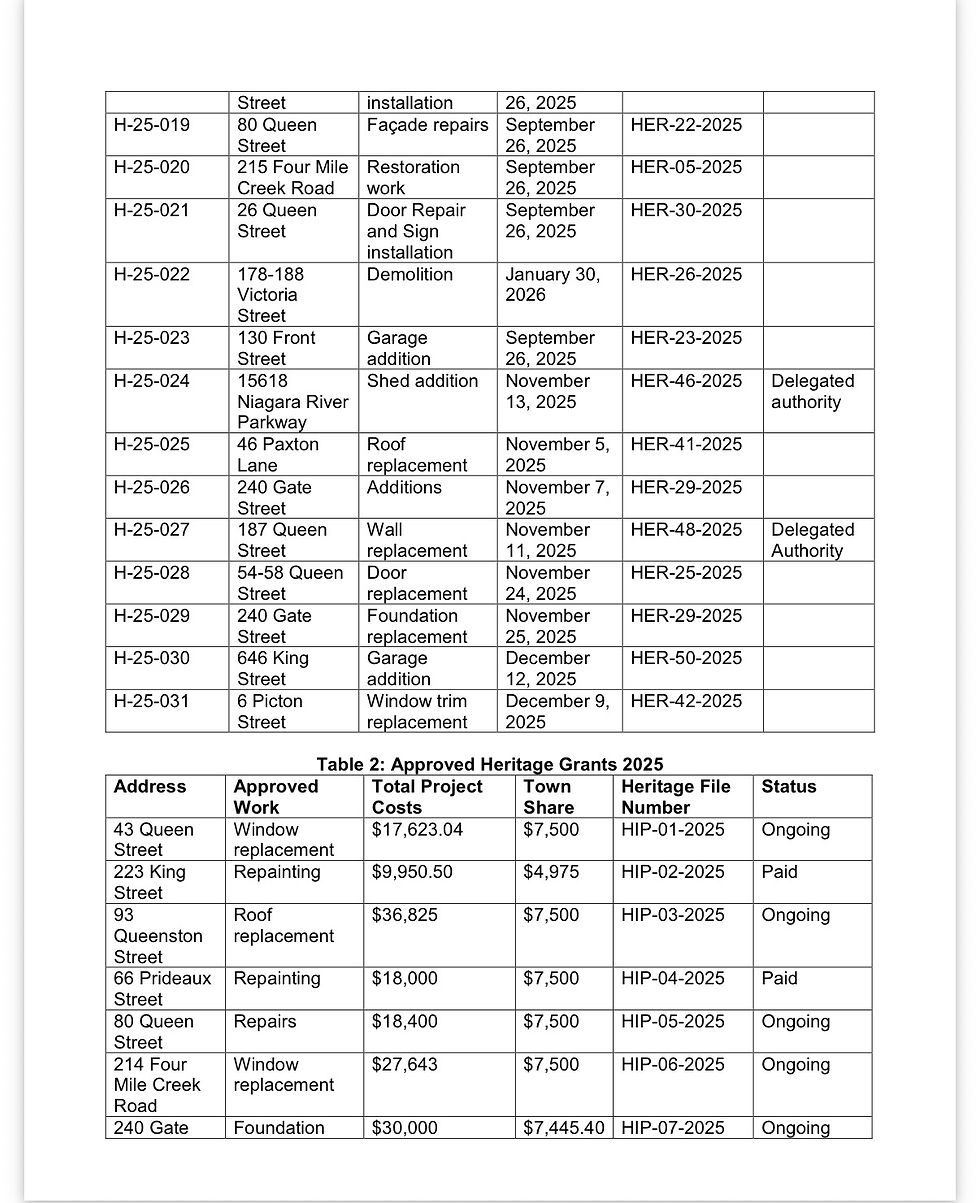
Reviewed 50 applications and reports
Approved 30 Heritage Permits
Reviewed and approved 8 Heritage Grants
Reviewed 8 cultural heritage evaluation reports
Reviewed Heritage Impact Assessments
Reviewed multiple demolition requests
Continued work on the Queen-Picton Heritage Conservation District expansion
Heritage Grants & Restoration Investment
The Heritage Grant Program alone supported projects such as:
window replacements
roof restorations
repainting
façade repairs
foundation restoration
door restoration
Examples include:
43 Queen Street
80 Queen Street
214 Four Mile Creek Road
240 Gate Street
93 Queenston Street
These are not examples of “overdevelopment.”
These are examples of property owners investing substantial private dollars into preserving the character of our town.
The Reality Behind the Headlines
It is easy to look at a single application and react emotionally.
But the reality is that Niagara-on-the-Lake is balancing:
heritage preservation
tourism
housing
infrastructure
agriculture
economic development
environmental protections
intensification policies from higher levels of government
resident concerns
business investment
All while staff process hundreds of permits, dozens of planning applications, heritage files, inspections, reports, public meetings, and Council directions.
The Bigger Picture
This term of Council inherited:
delayed applications from the ICBL period
post-COVID recovery pressures
housing pressures
infrastructure backlogs
increasing provincial mandates
escalating construction costs
increasing resident expectations
Despite that, staff and committees have continued processing applications, protecting heritage assets, modernizing policies, and keeping investment moving in the community.
Development does not simply mean “new buildings.”
In Niagara-on-the-Lake, development also means:
restoring historic homes
preserving cultural heritage
improving infrastructure
supporting jobs
maintaining tax stability
improving properties
upgrading aging buildings
funding municipal operations
and ensuring the town continues to evolve responsibly rather than stagnate.
Whether someone supports or opposes a specific project, it is important to recognize the sheer amount of work being undertaken behind the scenes by the Building, Planning, and Heritage Departments every single year.
And the numbers show just how significant that work truly is.




Comments